
IPTV vs Netflix, Disney+ and Prime Video: Which Is Better in 2026?
You may keep Netflix for one series, Disney+ for family nights and Prime Video because Amazon Prime already fits your routine. Add live television or sport, and several small subscriptions can turn into a sizable yearly bill. The IPTV vs Netflix comparison therefore goes beyond price in 2026. You are really choosing between separate on-demand…
You may keep Netflix for one series, Disney+ for family nights and Prime Video because Amazon Prime already fits your routine. Add live television or sport, and several small subscriptions can turn into a sizable yearly bill. The IPTV vs Netflix comparison therefore goes beyond price in 2026. You are really choosing between separate on-demand libraries and a more television-led internet experience
Streaming has become a normal part of viewing in France. CNC reported €694.6 million in subscription video-on-demand revenue during the first quarter of 2026, up 17.5% year on year. Around 57.2% of French internet users aged three and above used a subscription VOD service during the period. The series represented 78.5% of consumption across Netflix, Disney+ and Prime Video, showing how strongly on-demand viewing now shapes household entertainment.
IPTV vs Netflix, Disney+ and Prime Video at a Glance
Netflix, Disney+ and Prime Video mainly work as SVOD platforms, where you choose content from a controlled on-demand catalogue. IPTV describes television delivered over an IP network and can include live channels, an EPG, replay and VOD when a properly authorised provider offers those features. Your provider controls access, your player organises the service and your broadband carries the stream. Each part affects what you finally see on your television.
| Feature | IPTV | Netflix | Disney+ | Prime Video |
| Main experience | Live TV + VOD depending on service | Films and series | Family entertainment and franchises | Films, series and Prime ecosystem |
| Live television | Provider dependent | Limited | Limited | Selected live content |
| VOD | Provider dependent | Yes | Yes | Yes |
| Recommendations | Depends on player | Advanced | Strong | Strong |
| 4K | Source and device dependent | Premium plan | Premium plan | Selected titles |
| Offline viewing | App dependent | Yes | Yes on eligible plans | Eligible content |
| Content source | Depends on provider rights | Netflix catalogue | Disney catalogue | Amazon catalogue |
| Best fit | TV-led viewing | Personalised SVOD | Families and franchises | Existing Prime users |
Why Subscription Fatigue Matters in 2026
Streaming originally felt simple because one or two services covered much of what many people wanted. Now a series may sit on Netflix, a Marvel title on Disney+, another production on Prime Video and live sport on a separate broadcaster. You can spend more time remembering where a programme lives than choosing what to watch. That fragmentation is why searches around IPTV vs streaming services and streaming alternatives have grown more relevant.
Cost is only part of the frustration. Every service brings another account, interface, recommendation feed and renewal date. A household media hub can feel more convenient when live television and authorised VOD sit inside one organised interface. Convenience still depends on how well the provider and IPTV player structure the catalogue.
How Much Do Netflix, Disney+ and Prime Video Cost in France?
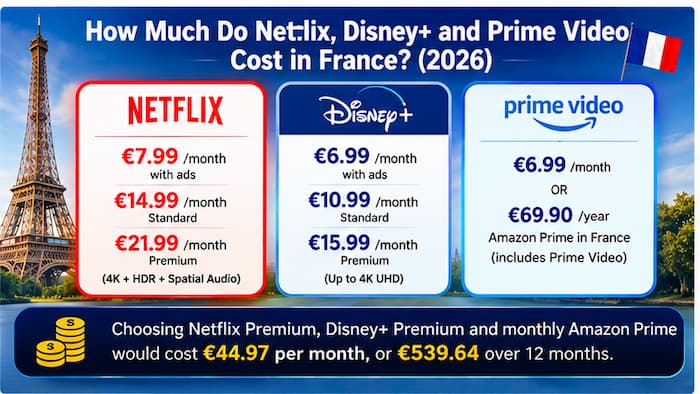
Netflix currently charges €7.99 per month with ads, €14.99 for Standard and €21.99 for Premium in France. Premium includes 4K + HDR and spatial audio on compatible content and hardware. Disney+ currently lists €6.99 with ads, €10.99 for Standard and €15.99 for Premium, with Premium offering up to 4K UHD and four concurrent streams.
Amazon Prime costs €6.99 per month or €69.90 per year in metropolitan France and includes Prime Video alongside wider Amazon benefits. Choosing Netflix Premium, Disney+ Premium and monthly Amazon Prime would cost €44.97 per month, or €539.64 over twelve months. Add paid sports packages and your entertainment budget can rise further because sports rights are divided between different broadcasters.
How Does IPTV Pricing Compare?
IPTV pricing varies by provider, duration, connections and support level. 4K French IPTV currently displays plans from €10 for one month, with a twelve-month plus one-month offer listed at €45. The site also advertises live channels, VOD, EPG features and support across common streaming devices.
A cheaper figure does not make an IPTV plan identical to Netflix, Disney+ or Prime Video. Those platforms license and control their own catalogues, while IPTV content depends on the rights held by each provider. When you compare IPTV subscription plans built around different viewing periods, price makes more sense alongside stability, device compatibility, content rights and support.
IPTV vs Netflix for Live TV, Sport and VOD
Netflix and Disney+ remain heavily centred on on-demand viewing. Prime Video mixes on-demand entertainment with selected live events, while IPTV can follow a more familiar television model with live channels and programme schedules. If you still watch news, scheduled programmes or sport in real time, that difference can matter more than the number of films in a library.
Sport also makes subscription fragmentation more obvious. Rights can sit with Canal+, beIN Sports, DAZN or another authorised broadcaster depending on the competition and season. An IPTV service may technically carry live streams, but availability must follow distribution rights. Arcom confirms that watching sport through an unauthorised IPTV service is illegal in France.
IPTV VOD vs Netflix and Disney+ Catalogues
A modern IPTV interface can combine live television with a VOD section, so you do not always need to move between separate menus. That centralised layout is one of the strongest ideas behind an all-in-one media hub. A search bar, categories and favourites can make a large library easier to navigate when metadata is organised properly.
A central library must not be confused with ownership of every streaming exclusive. Netflix Originals, Disney franchises and Prime exclusives remain governed by licensing rights. IPTV does not automatically grant lawful access to protected catalogues simply because a title appears inside an app. Arcom specifically warns that IPTV becomes unlawful when protected content is supplied without authorisation from rights holders.
4K, HEVC, Audio and Subtitles
Picture quality depends on far more than a 4K badge. Source quality, bitrate, HEVC/H.265 encoding, server delivery, broadband, decoding hardware and your television all sit in the playback chain. Netflix Premium offers 4K + HDR, while Disney+ Premium supports up to 4K UHD on compatible content and devices.
HEVC is also used for IPTV streams to deliver high res video more efficiently but the original source still determines how much detail gets to your screen. Multi channel audio and subtitles depend on the stream, player and available metadata. Players such as TiviMate or Smarters may support multiple audio tracks and subtitle options, while external subtitle behaviour varies by app and configuration.
Netflix Recommendations vs IPTV Search
Netflix has a major advantage when you do not know what to watch. Your viewing activity feeds a recommendation system that surfaces films and series based on previous behaviour. The relationship between profile data, content metadata and recommendations reduces the effort needed to discover another programme.
IPTV players are usually more focused on channel organisation, EPG navigation, categories and manual search. The experience can change noticeably between apps because interface speed, playlist handling and device support are player-dependent. Choosing an IPTV player that matches your device and viewing habits can therefore matter almost as much as the subscription itself.
Device Choice and the Multimedia Hub Experience
Major SVOD platforms work across Smart TVs, phones, tablets, computers, game consoles and streaming sticks. Your profile and viewing progress usually follow your account across supported hardware. That controlled ecosystem gives Netflix, Disney+ and Prime Video a polished multi-device experience.
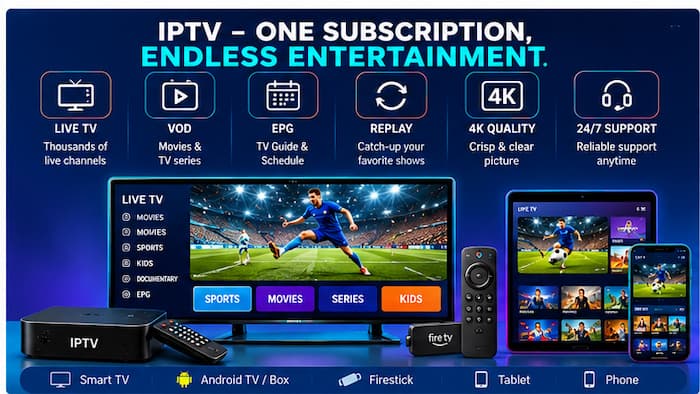
IPTV gives you another type of flexibility because the service and player can be separate. You may use Firestick, Android TV, Smart TV, iPhone, iPad, Windows or Mac with a compatible player. The setup changes slightly between screens, so installing IPTV across different devices is easier when you follow the method designed for your own hardware.
Account Sharing and Offline Viewing
Household rules have become another factor when you compare IPTV vs Netflix. Netflix plans define simultaneous viewing and account features, while Disney+ Premium currently supports four concurrent streams. IPTV connection limits vary by provider; support for several device types doesn’t mean every screen can play at once.
SVOD platforms also benefit if you’re traveling to locations where the internet connection isn’t reliable. Netflix permits you to download eligible content to watch offline, and Disney+ Premium and Standard permit downloads on compatible devices. IPTV still relies more on having an active connection, especially for watching live television.
Is IPTV Legal in France?
IPTV technology is legal in France. Arcom defines IPTV as a neutral technology for delivering audiovisual content over the internet. A legal problem appears when channels, films, streaming platforms or sports are supplied without permission from the relevant rights holders.
You should therefore treat content authorisation as a buying factor, not a footnote. A very large premium catalogue at an unusually low price deserves extra scrutiny. Price, content rights, security, stability and support all belong in the same decision.
IPTV or Netflix: Which One Fits You Better?
Netflix might be the better choice for you if films, series and personalized discovery are your evening staples. Disney+ makes sense when Disney, Pixar, Marvel and Star Wars are regular choices in your household, Prime Video adds value when you’re already benefiting from Amazon Prime. You may find that keeping one favourite SVOD service gives you more value than maintaining several subscriptions you barely open.
An authorised IPTV service can suit you better when live television, EPG navigation and flexible player choice matter more. You do not have to treat IPTV vs SVOD as an all-or-nothing decision. A balanced setup can combine live internet television with one streaming platform that genuinely matches your viewing habits.
Final Verdict
The IPTV vs Netflix, Disney+ and Prime Video debate has no universal winner. Netflix leads in personalised discovery, Disney+ has a strong franchise ecosystem, Prime Video benefits from the wider Amazon membership and IPTV can offer a more traditional internet-TV experience. Subscription fatigue makes consolidation attractive, but content rights and service quality still matter.
Look at what you watch during a normal week before comparing headline catalogue numbers. Check your yearly cost, preferred devices, live-TV habits, 4K needs and the services you actually open. The best setup is the one you keep using after the novelty of a new subscription disappears.
Frequently Asked Questions
Is IPTV cheaper than Netflix, Disney+ & Prime Video combined?
IPTV can be cheaper depending on the provider and plan. Netflix Premium, Disney+ Premium and monthly Amazon Prime currently cost €44.97 per month in France. The services aren’t like for like so should be compared on content rights, quality and support as well as price.
Is IPTV a Netflix replacement?
IPTV can replace some of your television habits when live channels and a TV-style interface are more important than others. It cannot automatically replace Netflix’s licensed catalog, Originals or recommendation system.
Is IPTV better than Netflix for 4K?
Neither option wins automatically. Netflix Premium offers 4K + HDR on compatible content, while IPTV quality depends on the source, bitrate, codec, server, broadband and device. Your television can only display the quality that reaches it.